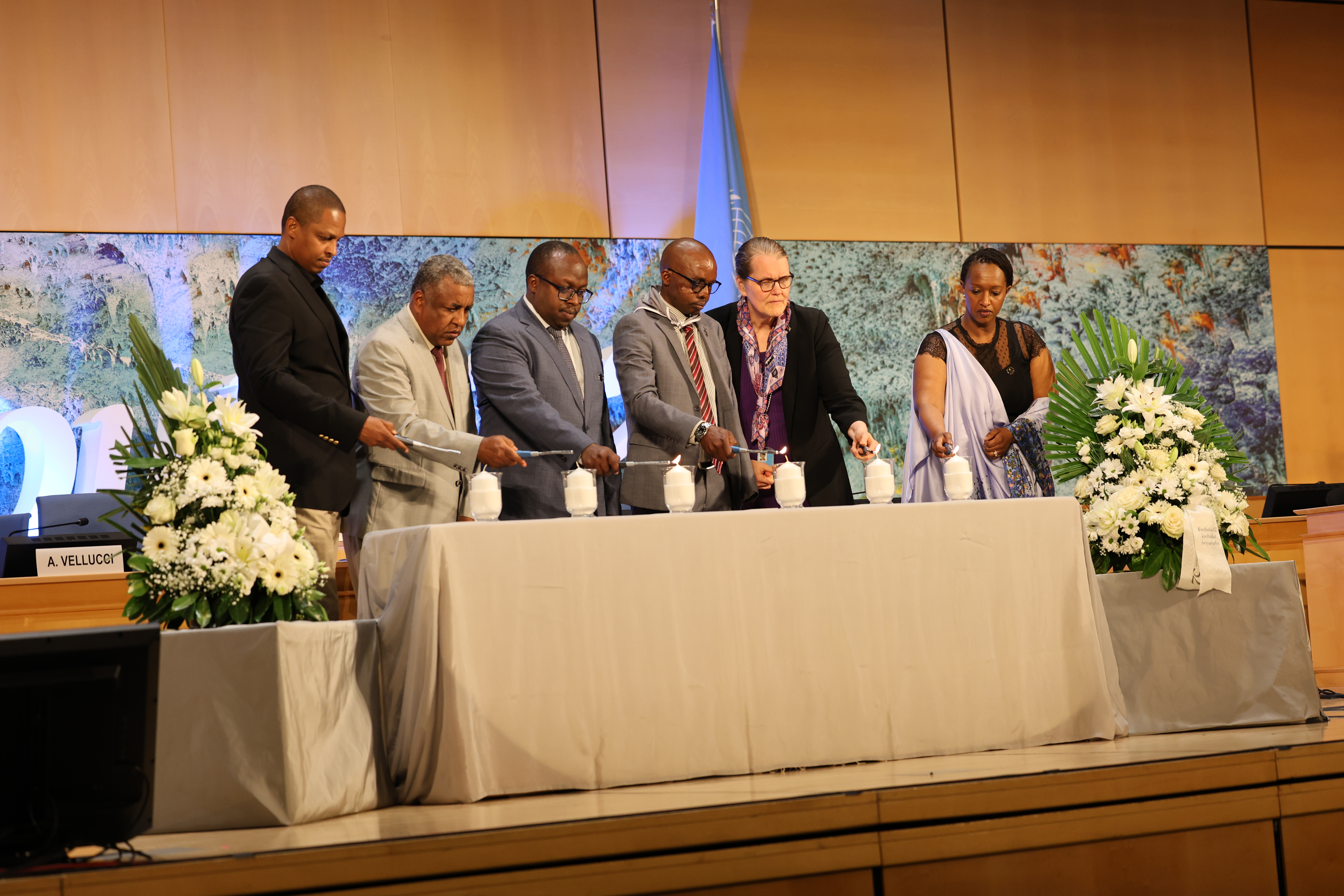
Kwibuka32 in Geneva renews the call for global accountability and shared responsibility to prevent crimes of genocide
Geneva, 7 April 2026 — Members of the Diplomatic Corps, representatives of the international community, the Rwandan diaspora in Switzerland and friends of Rwanda gathered today in Geneva to observe the 32nd Commemoration of the 1994 Genocide against the Tutsi in Rwanda.
The Commemoration began with a solemn Wreath-Laying Ceremony at the Memorial Stele, located at the Place des Nations, where participants, including Geneva city officials paid tribute to the more than one million lives lost during the 1994 Genocide against the Tutsi in Rwanda.
The second part of the commemoration continued in the Assembly Hall of the United Nations Office at Geneva, Palais des Nations. The programme featured the message of the Secretary-General of the United Nations, delivered by Ms. Kira Kruglikova, Director of the Division of Administration at UN Geneva, a video message by H.E. Tatiana Valovaya, Director-General of the United Nations Office at Geneva, and a video message by Mr. Volker Türk, United Nations High Commissioner for Human Rights.
Mr. César Murangira, President of Ibuka Suisse Mémoire et Justice, also delivered remarks on behalf of genocide survivors, renewing the call for memory, truth, justice and accountability.
In her remarks, Rwanda’s envoy to Switzerland and to the United Nations Office at Geneva and other international organizations, Ambassador Urujeni Bakuramutsa, emphasized that the commemoration serves as a renewed call for global accountability and shared responsibility to prevent genocide and atrocity crimes wherever warning signs emerge. She further underscored the importance of upholding the promise of Never Again as a living commitment of the international community.
‘’Thirty-two years on, regrettably, hateful rhetoric, alongside organized denial and revisionist networks, continue to minimize the planning, scale, and intent of the Genocide. The threats to historical truth remain present and have evolved. The same ideas once spread through extremist radio and propaganda now circulate more rapidly through digital platforms. Falsehood, distortion, hate, and incitement can now spread faster, across borders and with few barriers or consequences. Their persistence underscores that genocide ideology did not end in 1994. It has endured, adapted, and must be addressed wherever it appears.
Individuals suspected of participating in the Genocide against the Tutsi should not find refuge or impunity beyond Rwanda’s borders. States that host such individuals bear a responsibility under international law: to prosecute, to extradite, or otherwise to ensure that accountability is not undermined by time, distance, or political convenience. Justice addresses the crime. Prevention requires confronting the ideology that enabled it.’’
The testimony of Genocide survivor Mr. Reverien Rurangwa reflected both the horror endured by the victims of the 1994 Genocide against the Tutsi and the extraordinary resilience through which survivors and the Nation rose to rebuild. His testimony also underscored the importance of transmitting the memory and lessons of the Genocide to younger generations, so that the promise of Never Again remains a living responsibility.
The Ceremony featured musical interludes that brought together Rwandan artists from different generations, including Mariya Yohana, Weya Viatora and Daniel Ngarukiye, offering a meaningful space for collective reflection and remembrance.
In Switzerland, the 32nd Commemoration of the 1994 Genocide against the Tutsi will continue throughout the 100 days of mourning, including a remembrance vigil in Lausanne on 11 May 2026, bringing together members of the diaspora and friends of Rwanda.

Rwanda Engages International Organizations on the Sidelines of Political Consultations with Switzerland

Rwanda Participates in the Second Rwanda–Switzerland Bilateral Political Consultations

Second Rwandan Youth Retreat to Take Place in Geneva

Rwandan Community in Austria Celebrates Umuganura 2026

Rwanda’s Statement at the Organizational Meeting in relation to the 63rd Regular Session of the Human Rights Council

Rwanda's Statement | First Session of the Open-Ended Intergovernmental Working Group on a legally binding instrument for the promotion and protection of the Human Rights of Older Persons.

Rwanda's Statement at the 68th Series of Meetings of the WIPO Assemblies

Rwanda Participates in the Global Dialogue on AI Governance, WSIS Forum 2026 and AI for Good Global Summit
